

Lab Introduction & Major Research Interests
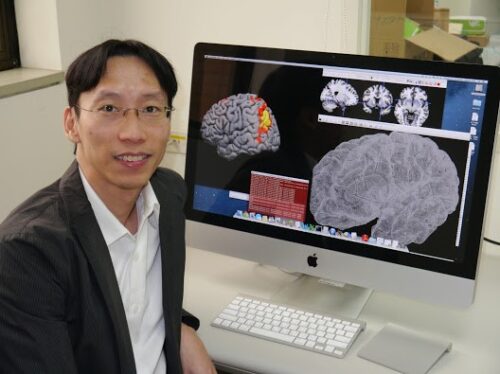
The human brain is a remarkable organ that is able to effortlessly integrate information across multiple dimensions, make sense of it, and generate actions to interact with its environment. My lab (http://gibms.mc.ntu.edu.tw/bmlab/) is deeply interested in understanding how the brain does this work, and how it is affected by various factors. We ask questions like how brain structure and function ages, how this is associated with cognitive aging, how this impacts decisions that young or older persons make, and how brain aging is different across cultural experiences. We also investigate the notion of the brain as a Bayesian machine and how this model of the brain might be leveraged in enhancing human cognition or addressing its issues. To this end, we also study human neural inferential processing of spatial, social, and conceptual information, as well as evaluate artificial neural networks as models of the inferential brain. Our primary techniques used include magnetic resonance imaging and analysis of the human brain, neurocognitive assessments, and psychological experiments. We collaborate with various others in the fields of Psychology, Electrical Engineering, and Medicine, at various locations including National Taiwan University and National Cheng Kung University in Taiwan, and Brandeis University and the National Institute on Aging in the USA.
Recent Representative Publication ( * corresponding author)
1. Chuang, Y. S., Hung, H. Y., Gamborino, E., Goh, J. O.S.*, Huang T. R., Chang, Y. L., Yeh, S. L., Fu, L. C. (2019). A neural network that learns the social preferences of individuals. TAICHI 2019, National Taiwan University, Taipei, Taiwan.
2. Chen, C. C., Su, Y. S., Tu, Y. Z., Goh, J. O. S.* (2019). Default-mode network activation underlies accurate contextual processing of exclusive disjunctions in older but not younger adults, NeuroImage, 201, 116012.
3. Zhang, W., Hung, I. T., Jackson, J. D., Tai, T. L., Goh, J. O. S., Gutchess, A.* (2019). Influence of culture and age on the self-reference effect. Aging, Neuropsychology, and Cognition, 23, 1-15.
4. Goh, J. O. S.*, Hung, H. Y., Su, Y. S. (2018). A conceptual consideration of the free energy principle in cognitive maps: How cognitive maps reduce surprise. In Kara Federmeier (Ed.), Psychology of Learning, and Motivation, 69, 205-240.
5. Su, Y. S., Chen, J. T., Tang, Y. J., Yuan, S. Y., McCarrey, A. C., Goh, J. O. S.* (2018). Age-related differences in striatal, medial temporal, and frontal involvement during value-based decision processing. Neurobiology of Aging, 69, 185-198.
6. Goh, J. O. S.*, Su, Y. S., Tang, Y. J., McCarrey, A. C., Tereschenko, A., Elkins, W., Resnick, S. M. (2016). Frontal, striatal, and medial temporal sensitivity to value distinguishes risk-taking from risk-aversive older adults during decision-making. Journal of Neuroscience, 36(49), 12498-12509.